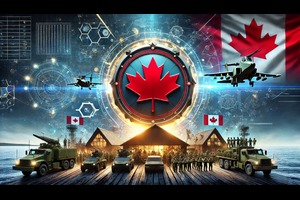

For years, Canadian defence debates have been dominated by familiar themes, fighter jets, Arctic sovereignty, peacekeeping nostalgia, and the perennial question of whether Canada is doing its “fair share” within NATO. What has received far less attention is the most unglamorous, uncelebrated, and yet most decisive element of modern land warfare: artillery.
In an age of artificial intelligence, hypersonic missiles, and stealth aircraft, it is easy to assume that artillery belongs to a bygone era , a relic of the First and Second World Wars, a weapon of attrition rather than precision. But the war in Ukraine has shattered that illusion. Artillery has not only remained relevant; it has reasserted itself as the backbone of contemporary conflict. It shapes the battlefield, dictates tempo, and determines survival. It is the instrument that turns intelligence into effect, and strategy into outcomes.
For Canada, a country of continental scale and global responsibilities, the lesson is unavoidable. If Canada intends to be a serious military actor , not merely in rhetoric but in capability , it must confront a simple truth, its artillery force is dangerously small, technologically outdated, and strategically insufficient. A nation of this size, geography, and alliance commitments cannot rely on a handful of howitzers scattered across a vast territory. It needs mass, depth, and modernity.
A credible starting point is a procurement of 500 modern self-propelled artillery systems, with a long-term objective of 1,000 units , a number appropriate for a country that spans an ocean-to-ocean frontier and anchors the northern flank of the world’s most important military alliance.
This is not an argument for militarism. It is an argument for realism.
A Continental Nation With a Battalion-Sized Arsenal
Canada is the second-largest country on Earth, yet its artillery inventory is closer to that of a small European state. The Canadian Army currently fields only a few dozen modern 155-millimeter M777 howitzers, supplemented by aging 105-millimeter guns that belong more to the Cold War than to the 21st century. These systems are capable, but they are few, fragile, and increasingly outmatched by the demands of modern warfare.
The mismatch between Canada’s geography and its artillery capacity is stark. The country’s landmass is larger than that of the United States, yet its artillery force is smaller than that of many mid-sized NATO members. The Arctic , a region of growing geopolitical tension , remains largely undefended by modern ground-based firepower. And within NATO, Canada’s contribution to collective deterrence is constrained not by political will but by material scarcity.
This is not merely a matter of numbers. It is a matter of credibility. A nation that aspires to shape global security cannot do so with a force structure that lacks the most fundamental tools of land combat.
The War That Rewrote the Textbooks
The Russia–Ukraine war has become a brutal laboratory for 21st-century warfare. It has shown that artillery , when paired with drones, sensors, and digital fire-control networks , remains the decisive arm of ground combat. Precision shells, counter-battery radars, and AI-enabled targeting have transformed what was once a blunt instrument into a highly responsive, data-driven system.
The result is clear: artillery is not a relic. It is the backbone of modern warfare.
The conflict has also revealed something else: the limits of airpower. Many Western analysts assumed that advanced aircraft would dominate any future conflict. But in Ukraine, dense air-defense networks have sharply restricted the use of both Russian and Ukrainian air forces. The skies are contested, dangerous, and unforgiving. Drones , cheap, expendable, and ubiquitous , have replaced fighter jets as the primary eyes of the battlefield.
In this environment, artillery has become the central tool for shaping the fight. It is the weapon that destroys supply lines, halts advances, and breaks fortified positions. It is the weapon that turns intelligence into effect. And it is the weapon that determines whether soldiers live or die.
Canada cannot afford to ignore this reality.
A $10-Billion Commitment to Modern Fires
A national artillery renewal program ,backed by a $10-billion budget ,would not only modernize the Canadian Army but also anchor a domestic industrial base capable of sustaining it. South Korea, France, Sweden, and other advanced manufacturers could compete to supply the initial tranche of systems, with the first 50 units imported to accelerate fielding.
The remaining production could shift to Canadian soil, creating a long-term partnership that blends foreign expertise with domestic manufacturing, maintenance, and innovation. Such an approach mirrors successful models used by Norway, Australia, and Poland, where imported systems evolved into local production lines and sovereign capabilities.
A phased approach would allow Canada to build capacity gradually:
- Phase 1: Import 50 systems to accelerate readiness.
- Phase 2: Assemble 200 systems in Canada, building a domestic workforce and industrial base.
- Phase 3: Procure an additional 250 systems, incorporating lessons learned and technological upgrades.
This structure would give Canada not only the equipment it needs but also the industrial resilience required to sustain it.
Why 500 and Why 1,000 in the Long Term
Critics may argue that 500 artillery systems is excessive for a country with a relatively small army. But this view misunderstands the nature of modern conflict and the responsibilities of a nation of Canada’s scale.
A force of 500 systems would allow Canada to:
- Equip multiple brigades with modern, self-propelled firepower
- Provide depth for training, maintenance, and attrition
- Support NATO operations in Europe
- Defend the Arctic with credible ground-based deterrence
- Maintain a strategic reserve for emergencies
A long-term objective of 1,000 systems is not extravagant. It is proportional. It reflects the reality that Canada is not a small state but a continental power with global responsibilities. It reflects the reality that deterrence requires mass, not symbolism. And it reflects the reality that modern warfare is defined not by the number of soldiers a country fields but by the capabilities it can bring to bear.
Strengthening Canada Means Strengthening NATO
NATO’s credibility depends not only on the United States but on the collective strength of all its members. A Canada equipped with a robust, modern artillery force would significantly enhance the alliance’s northern flank, contribute meaningfully to European security, and reinforce deterrence in an increasingly unstable world.
A stronger Canada is a stronger NATO.
This is not a slogan. It is a strategic fact. The alliance’s ability to deter aggression depends on the readiness and capability of each member state. Canada’s geography gives it a unique role: it anchors the Arctic, connects the Atlantic and Pacific, and provides strategic depth to North America. But geography alone is not enough. It must be matched by capability.
The Responsibility of Scale
Great powers are not defined solely by GDP or population. They are defined by the seriousness with which they approach their own security. For a nation of continental dimensions, Arctic responsibilities, and global alliances, investing in technologies that remain strategically relevant is not optional ,it is leadership.
Artillery may not be glamorous. It does not dominate headlines or political speeches. But it wins wars, shapes peace, and anchors deterrence. It is the weapon that turns intelligence into effect, and strategy into outcomes. It is the weapon that defines whether a nation can defend itself and contribute meaningfully to collective security.
Canada’s leaders would do well to take note.
A Moment for Clarity
The world is entering a period of strategic uncertainty. The assumptions that shaped the post-Cold War era , that conflict would be limited, that technology would replace mass, that geography no longer mattered , have been overturned. The war in Ukraine has shown that industrial capacity, ammunition stockpiles, and artillery mass are once again central to national security.
Canada cannot rely on geography alone. It cannot rely on allies alone. It cannot rely on outdated assumptions about the nature of modern warfare.
It must invest in the capabilities that matter , the capabilities that win wars, deter aggression, and protect sovereignty.
A 500-gun artillery force is not an extravagance. It is a necessity. A 1,000-gun long-term objective is not ambition. It is responsibility.
Canada is a nation of scale. Its defence policy must reflect that scale.