Brantford at 2050- The Mid-Sized Ontario City That Must Think Like a $40-Billion Economy
There are moments in the life of a city when its future quietly pivots. Not with fireworks or ribbon-cuttings, but with a single investment decision, a shift in political imagination, or a new understanding of geography. Brantford, Ontario ,long overshadowed by its larger neighbours , is standing at precisely such a moment. For decades, it was known for Wayne Gretzky, Alexander Graham Bell, and a manufacturing base that once collapsed under the weight of globalization. Today, it is emerging as one of the most strategically placed cities in the province, and perhaps the most underestimated.
If Ontario is serious about its ambition to become a $4-trillion economy by 2050, then Brantford cannot remain a modest city of 120,000. It must grow deliberately, aggressively, and with a clear sense of purpose , into a city of 250,000+ people and a $40-billion GDP. This is not boosterism. It is arithmetic, geography, and policy aligning at the right time.
The clearest sign of this shift came in December 2025, when a Canadian delegation travelled to France and returned with one of the most consequential industrial wins in the city’s modern history. Massilly North America, a major European packaging manufacturer, committed $85 million to build a state-of-the-art can-manufacturing facility in Brantford. The project will create 50 new high-quality manufacturing jobs, secure 228 existing positions, and reshore critical supply chain capabilities to Ontario. For a city of Brantford’s size, this is the equivalent of a billion-dollar auto plant landing in Toronto. It signals that global investors now see Brantford not as a peripheral town, but as a strategic node in the province’s industrial corridor.
This is the kind of investment that changes a city’s trajectory. But it is also a reminder that Brantford’s future will not be shaped by nostalgia or incrementalism. It will be shaped by whether its leaders municipal, provincial, and federal are willing to think in 30-year horizons rather than three-year election cycles.
Brantford’s importance to Ontario’s economic future rests on three pillars. The first is geography. The city sits at the western edge of the Greater Golden Horseshoe, with direct access to Hamilton’s port, Highway 403, the US border, and the Kitchener-Waterloo tech corridor. It is close enough to the GTA to benefit from its gravitational pull, yet far enough to offer the land, affordability, and breathing room that Toronto no longer can. This is the kind of geography that cities like Austin, Raleigh, and Eindhoven used to transform themselves into innovation and manufacturing hubs.
The second pillar is Brantford’s industrial base. Unlike many mid-sized cities that rely on a single dominant sector, Brantford has quietly built a diversified economy: food processing, advanced manufacturing, plastics, packaging, logistics, and automotive components. This diversity is a strength. It means the city is not vulnerable to the collapse of a single industry, and it gives investors confidence that Brantford can support complex supply chains.
The third pillar is cost advantage. Brantford remains one of the few cities in the region where land is still affordable, housing is still within reach, and industrial space is available. For global manufacturers looking to reshore production, these factors matter as much as tax incentives or labour availability. Brantford offers something rare in Southern Ontario: room to grow.
But geography and cost advantages alone will not deliver a $40-billion economy. Brantford must plan for growth on a scale it has never attempted. A city cannot double its population without transforming its housing, transportation, and industrial footprint. It must build for the city it wants to be, not the city it has been.
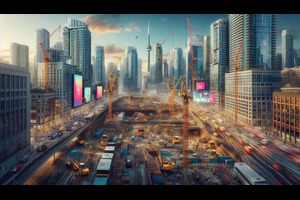
Housing is the first frontier. Brantford must adopt a “2050 Housing Compact” that envisions a city of 250,000 residents. That means high-density corridors along major roads, 20- to 30-storey mixed-use towers in the downtown core, and transit-oriented development around future GO service. The city needs at least 50,000 new homes by 2050 a mix of rental, ownership, student housing, and affordable units. Without housing, Brantford cannot attract workers. Without workers, it cannot attract industry. Without industry, it cannot reach $40 billion.
Transportation is the second frontier. Brantford must be connected to the GTA by two-way, all-day GO train service by 2035. This is not a luxury. It is the backbone of a modern, mid-sized city. Fast rail links talent to jobs, students to campuses, and investors to opportunities. It also reduces pressure on highways and makes the city more attractive to young families priced out of the GTA.
The third frontier is industrial expansion. Brantford must plan for 10 million square feet of new industrial space by 2050. This includes advanced manufacturing, food processing, clean-tech, packaging, battery components, and crucially the emerging supply chain for small modular reactors (SMRs). Canada is quietly becoming the global leader in SMR deployment, with the first Western SMR the BWRX-300 under construction in Ontario. SMRs require fabrication, materials, control systems, logistics, and skilled labour. Brantford is perfectly positioned to become a Tier-2 SMR supply chain hub, feeding into projects at Darlington, Bruce, Pickering, and future deployments across Canada, the US, the UK, and India.
This is not speculative. It is industrial policy meeting geography. If India and other nations adopts SMRs at scale and it will Brantford can be part of that supply chain. The city’s manufacturing base, land availability, and proximity to Ontario’s nuclear corridor make it an ideal partner.
To attract the next billion dollars in investment, Brantford must adopt a more aggressive economic development strategy. It needs a dedicated Brantford Investment Agency, modeled on Invest Ottawa or Waterloo EDC, with a mandate to target European manufacturers, US reshoring firms, clean-tech companies, and nuclear supply chain firms. It needs a 500-acre industrial mega-site capable of hosting large-scale manufacturing operations. And it needs to deepen its relationship with France, using the Massilly investment as the foundation for a “France–Brantford Industrial Corridor.”
Talent will be the decisive factor. Wilfrid Laurier University’s Brantford campus is the city’s most underrated asset. A city of 250,000+ needs a university with at least 10,000 students, offering programs in engineering, AI, supply chain management, and nuclear technology. A research park tied to advanced manufacturing and SMRs would anchor the city’s innovation ecosystem. Talent is the currency of the 21st century. Cities that grow talent grow GDP.
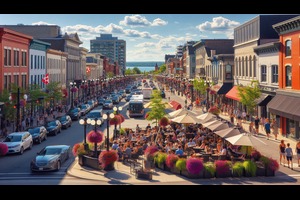
Downtown Brantford must also be reimagined. A city cannot double its population with a hollow core. The downtown must become a destination , a place where students, young professionals, and families want to live, work, and spend time. That means mixed-use towers, cultural spaces, pedestrian-first design, and a Laurier-anchored innovation district. A vibrant downtown is not a cosmetic upgrade. It is a competitive advantage.
None of this will happen without political leadership. Municipal leaders must think beyond election cycles. Queen’s Park must treat Brantford as a strategic growth centre, not a peripheral city. Ottawa must support housing, transit, industrial incentives, and immigration streams tailored to mid-sized cities. Brantford cannot do this alone.
By 2050, success will look like this: a population of 250,000+, a GDP of $40 billion, 10 million square feet of industrial space, 10,000 university students, a thriving SMR supply chain, and full two-way GO service. This is not a dream. It is a plan if the city chooses to pursue it.
Ontario’s $4-trillion ambition cannot be achieved by Toronto, Ottawa, and Waterloo alone. The province needs new engines, new centres of gravity, new industrial anchors. Brantford is one of the few cities with the geography, land, cost advantage, industrial base, and institutional stability to become a $40-billion economy by 2050.
The Massilly investment is the first chapter. The next 25 years will write the rest. Brantford must decide whether it wants to be a spectator in Ontario’s growth story or a central character. The window is open. The question is whether the city will walk through it.